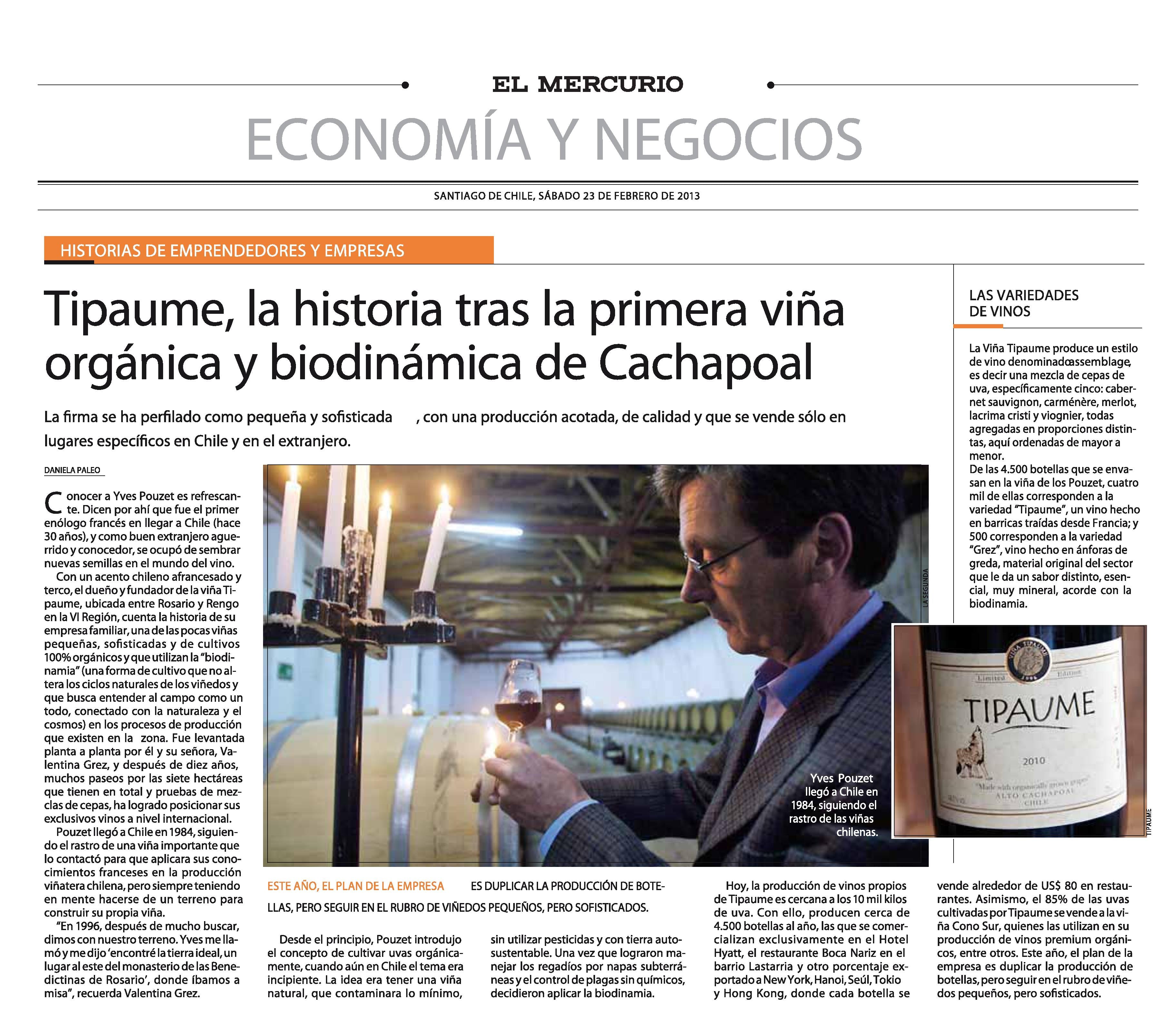

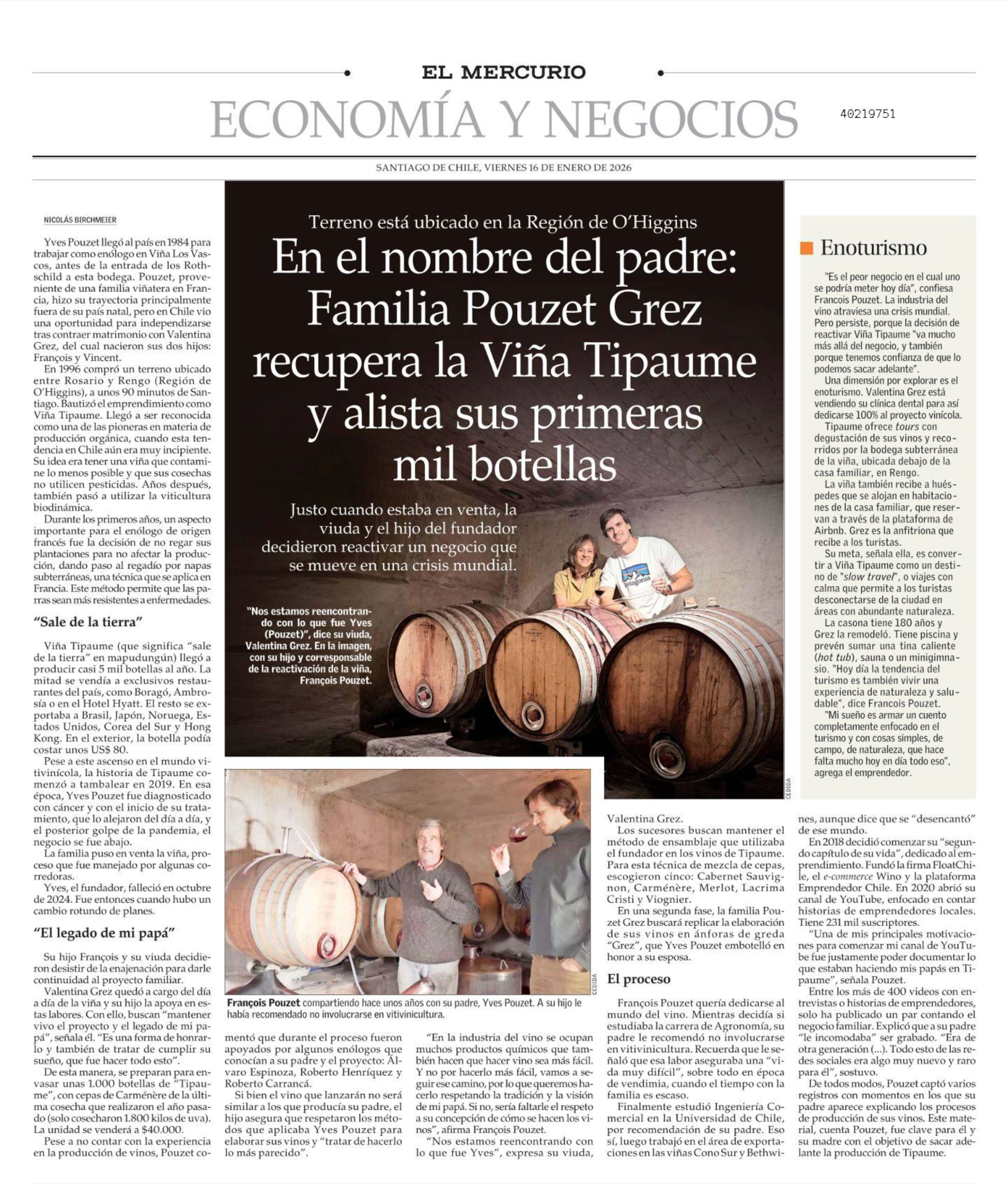
Pouzet Grez family recovers Viña Tipaume and prepares its first thousand bottles
In the father's name:
The Pouzet Grez family recovers Viña Tipaume and prepares its first thousand bottles
The land is located in the O'Higgins Region
Santiago, Chile, Friday, January 16, 2026
By Nicolás Birchmeier – El Mercurio, Economía y Negocios
Yves Pouzet arrived in the country in 1984 to work as a winemaker at Viña Los Vascos, before the Rothschilds entered this winery. Pouzet, from a winemaking family in France, mainly made his career outside his native country, but in Chile he saw an opportunity to become independent after marrying Valentina Grez, with whom he had two children: François and Vincent.
In 1996 he bought land located between Rosario and Rengo (O'Higgins Region), about 90 minutes from Santiago. He named the venture Viña Tipaume. It became known as one of the pioneers in organic production, when this trend in Chile was still very new. His idea was to have a vineyard that polluted as little as possible and whose harvests did not use pesticides. Years later, he also started using biodynamic viticulture.
During the first years, an important aspect for the French winemaker was the decision not to irrigate his plantations so as not to affect production, giving way to irrigation by underground aquifers, a technique applied in France. This method allows the vines to be more resistant to diseases.
"Comes from the earth"
Viña Tipaume (which means "comes from the earth" in Mapudungun) came to produce almost 5,000 bottles a year. Half were sold to exclusive restaurants in the country, such as Boragó, Ambrosía or the Hyatt Hotel. The rest was exported to Brazil, Japan, Norway, the United States, South Korea and Hong Kong. Abroad, a bottle could cost about US$80.
Despite this rise in the wine world, Tipaume's story began to falter in 2019. At that time, Yves Pouzet was diagnosed with cancer and with the start of his treatment, he stepped away from the day-to-day business. Then came the blow of the pandemic and the winery went under.
The family put the winery up for sale, a process handled by some brokers. Yves, the founder, passed away in October 2024. It was then that there was a complete change of plans.
"My dad's legacy"
His son François and his widow decided to withdraw from the sale to give continuity to the family project. Valentina Grez is in charge of the day-to-day operations of the winery and her son supports her in these tasks. With this, they seek to "keep my dad's project and legacy alive," he says. "It's a way to honor him and also to try to fulfill his dream, which was to do all this."
In this way, they are preparing to bottle some 1,000 bottles of Tipaume, with Carménère strains from the last harvest they carried out last year (they only harvested 1,800 kilos of grapes). Each unit will sell for $40,000.
Despite not having direct experience in wine production, François Pouzet comments that during the process they were supported by some winemakers who knew his father and the project: Álvaro Espinoza, Roberto Henríquez, and Roberto Carrancá.
Although the wine they will launch will not be similar to those produced by his father, he assures that they respected the methods Yves Pouzet applied to make his wines and "tried to make it as similar as possible."
“In the wine industry, many chemical products are used that also make winemaking easier. And we are not going to follow that path just to make it easier; we want to do it respecting my dad's tradition and vision. Otherwise, it would be disrespecting his conception of how wines are made,” says François Pouzet.
"We are reconnecting with who Yves was," says his widow, Valentina Grez.
The successors seek to maintain the blending method that the founder used in Tipaume wines. For this blend technique, they chose Cabernet Sauvignon, Merlot, Carménère, Lacrima Christi, and Viognier.
In a second phase, the Pouzet Grez family will seek to replicate the production of their wines in Grez clay amphoras, which Yves Pouzet bottled in honor of his wife.
The process
François Pouzet wanted to dedicate himself to the world of wine. While deciding whether to study Agronomy, his father advised him not to get involved in winemaking. He recalls his father telling him that the work ensured a "very difficult life," especially during harvest season, when time with family is scarce.
He eventually studied Commercial Engineering at the University of Chile, following his father's recommendation. He then worked in exports at the Cono Sur and Bethwines wineries.
Wine Tourism
“It's the worst business one could get into today,” confesses François Pouzet. The wine industry is going through a global crisis. But he persists, because the decision to revive Viña Tipaume “goes far beyond business, and also because we are confident that we can make it happen.”
One dimension to explore is wine tourism. Valentina Grez is selling her dental clinic to dedicate herself 100% to the wine project.
Tipaume offers tours with wine tasting and tours of the winery's underground cellar, located beneath the family home in Rengo. The winery also welcomes guests who stay in rooms in the family home, which they book through Airbnb. Grez is the hostess who receives the tourists.
Her goal, she says, is to turn Viña Tipaume into a destination for slow travel, or calm trips, that allow tourists to disconnect from the city in areas with abundant nature.
The 180-year-old mansion has been renovated. It has a swimming pool and they plan to add a hot tub, sauna, or a mini-gym. "Today, the trend in tourism is also to live a natural and healthy experience," says François Pouzet.
"My dream is to create a story completely focused on tourism with simple things, rural, natural, which is very much needed today," adds the entrepreneur.
In parallel, Pouzet decided in 2018 to begin his "second chapter of life," dedicated to entrepreneurship. He founded Float Chile, the e-commerce Wino, and the platform Emprendedor Chile. In 2020, he opened his YouTube channel, focused on telling stories of local entrepreneurs, which now has more than 231,000 subscribers.
"One of my main motivations for starting my YouTube channel was precisely to be able to document what my parents were doing at Tipaume," says Pouzet.
Among the more than 400 videos with interviews or stories of entrepreneurs, he has only published a couple about the family business. He explains that his father "was uncomfortable" being filmed. "He was from another generation. All this social media stuff was very new and strange for him."
Nevertheless, Pouzet captured several recordings with moments where his father appears explaining the production processes of his wines. This material was key for him and his mother to move forward with Tipaume's production.